White Mistletoe - The Ancient Medicinal Plant
Table of Contents
#Medicinal plants and grasses - united under the name herbs
The power of plants to help with various human health problems has been known for hundreds of years.
Medicinal plants and grasses, united under the name herbs, cover a large group of plants used in medical and veterinary practice for the prevention and treatment of disease.
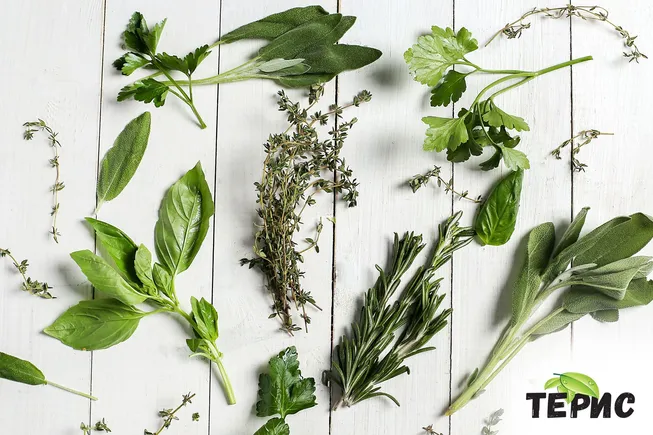
They are mentioned even in the works of scholars of antiquity: the Roman physician Galen (129 – c. 201), the founder of Greek medicine Hippocrates (460 – c. 370 BC), Dioscorides (1st century), and the Tajik physician and scholar Abu Ali Ibn Sina – Avicenna.
In his work “Enquiry into Plants” Theophrastus, called the father of botany, says that Thrace was the region richest in medicinal herbs in the world of that time. Dioscorides gives a detailed description of the herbs used by the Thracians in his work “On Medical Material”. The data on the Slavs indicate that they made use mainly of the medicinal properties of certain tree species – birch, pine, willow, fir, linden, dwarf mountain pine and ash.
One of the first sources on herbal healing practices in the Bulgarian state is the “Hexameron” by John the Exarch (7th century), which describes the treatment of pleurisy with willow, hellebore and poplar. The Bogomils were also known for their folk healing.

“Herbs have been shown to contain medicinally active substances that have a beneficial effect on the human body.”
Alongside these, they also contain accompanying substances that can enhance the effect of the medicinal substance or have a harmful influence.
The active substances are found to the greatest extent in the leaves and flowers of plants.
For the most part, the active substances in herbs are alkaloids and glycosides. They are contained in 2/3 of the medicinal herbs used by humankind.
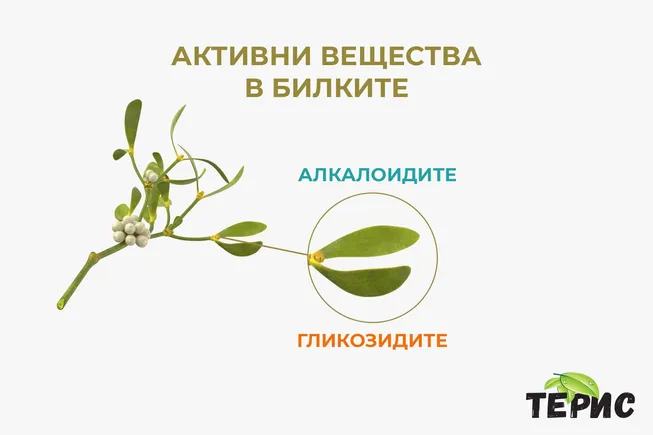
It has been shown that herbs can help in the treatment of many conditions – from problems with the respiratory system, through cardiovascular diseases, to muscle injuries and even emotional states.
#(H2) White mistletoe - one of the most revered herbs in Bulgaria
One of the most revered and well-liked plants in the Bulgarian lands is white mistletoe. It is a semi-parasitic shrub with fleshy leaves and small flowers. Modern medicine uses the leaves and twigs, or the leaves alone. They are picked in March and April.
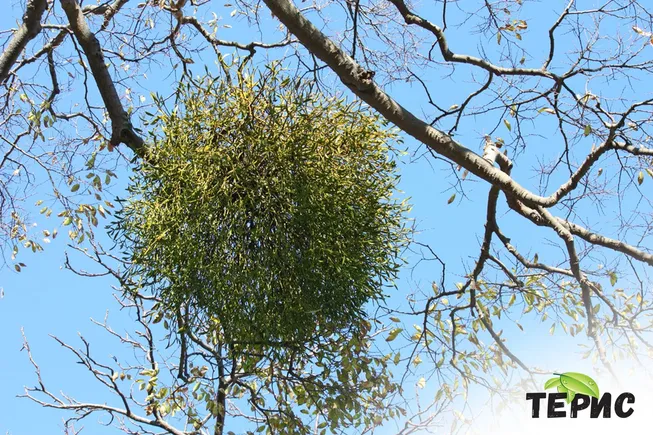
In old herbal books it is found under the folk names: thunder broom, witch's sign, wood of the Holy Cross.
This leads to the conclusion that white mistletoe is an ancient medicinal plantthat was used not only in our lands. In Bulgaria, different regions call it Byala lepka, Imela, Omela.
Mistletoe is one of the many species originally described by Linnaeus. Its species name is the Latin adjective albus - "white". It and the other members of the genus Viscum were originally classified in the mistletoe family Viscaceae , but gradually this family has been merged into the larger family Santalaceae.
In Europe, the most widespread species of mistletoe is white mistletoe. Its Latin name is “Viscum album”.
#(H2) Botanical characteristics
White mistletoe is partly parasitic. It grows on several woody hosts (trees and shrubs) in various habitats. It is also called a semi-parasite, because it draws minerals and water from the host tree, but at the same time, like other plants, it carries out photosynthesis with its leaves.
It grows on the branches of other trees, to which it is attached by a haustorium (a root-like structure that grows into or around another structure to absorb water or nutrients). It is hemiparasitic, which means that although it depends on the plant it has attached itself to, it can photosynthesise, as it has green leaves and stems.
As a small woody shrub, often spherical in shape, it can reach over 1 metre in diameter.
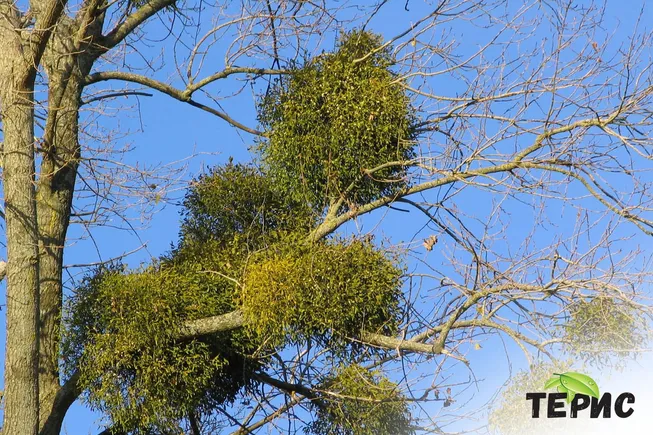
Its stems are 30–100 centimetres long with forked branching.
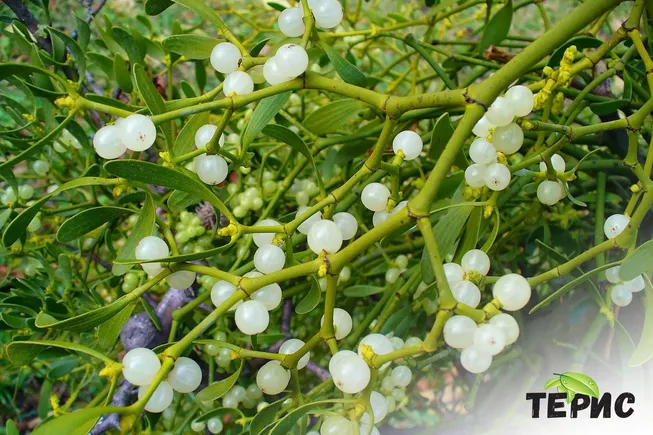
The leaves are in opposite pairs, strap-shaped, entire, of leathery texture, 2-8 cm long, 0.8-2.5 cm wide and yellowish-green in colour.
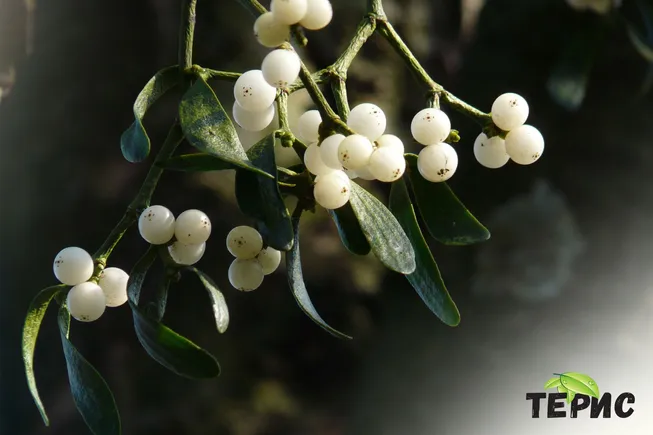
The fruit is a white or yellow berry with one or several seeds embedded in a very sticky pulp.
They are pollinated by insects and flower from about October to May.
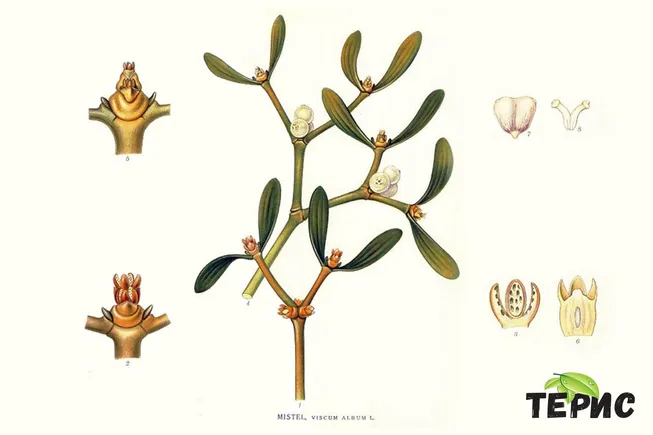
The stems of mistletoe are forked.
The male and female flowers are produced on separate plants.
#Interesting facts
- From the stems it is possible to work out the age of the shrub, by counting how many times the branches fork and adding two years.
- The plant goes by many different names among different peoples.
In German it is known as Mistel, Vogelmistel, Leimmistel, Affolter. In French it is gui, gui commun, gui de druides; in Italian: vischio, visco, vescovaggine, guatrice, pania, scoaggine; and in Spanish: muerdago.
- An interesting fact is that mistletoe is surrounded by a number of myths and legends and still plays a role in the folklore of some countries.
A legend from Italy, for example, says that if women carry a piece of white mistletoe on them, it will help them conceive if they have such a problem. Decoctions and medicinal preparations from the herb are used for women's ailments, and in combination with other herbs it helps with infertility. The Celts also used it as a remedy for infertility in animals.
In Greek mythology, mistletoe is used by heroes to gain access to the underworld. The Romans hung it over doors to protect the household.
Among some peoples there is a custom for lovers to kiss under mistletoe during the Christmas season. Mistletoe is often used as a Christmas decoration. According to custom, it must not touch the ground between being cut and being removed as the last of the Christmas greenery.
It can be left hanging all year round to protect the house from lightning or fire until it is replaced on the following Christmas Eve.
- It helps bring abundance in farming.
Many traditions hold that mistletoe helps bring abundance in farming. For this purpose, white mistletoe leaves were cut into pieces and the farmer would say a prayer over them, after which the fields were sown with millet and seeds of other cereal crops. Among some peoples, the most effective remedy was considered to be mistletoe growing on willow, which was regarded as a sacred tree.
- The ability to protect against witchcraft
But perhaps the most valuable asset of this plant, in the eyes of ancient peoples, was its ability to protect against witchcraft. Austrians placed a sprig of mistletoe on the threshold to protect against nightmares. People in the north of England say that if you want your dairy to prosper, you should feed a bunch of mistletoe to the first cow to calve after the New Year, so that nothing, such as spells, can harm the milk and butter. In Wales, too, sprigs of mistletoe were given to the cow that calved in the first hour after the New Year, so that things would go well in the dairy.
In Sweden, people diligently searched for mistletoe on the eve of the feast of St John the Baptist, because they believed this plant was so richly endowed with mystical qualities and magical power that if its branches were fixed to the ceiling of a dwelling, stable or manger, trolls were powerless to harm people and animals.
According to the Gauls, the effectiveness of this remedy was greater if the plant was picked on the first day of the full moon, without the use of iron, and if at the same time it was not placed on the ground. According to the belief, however, it could be cut with a golden sickle. Gathered in this way, the mistletoe herb was considered a good remedy for epilepsy. The Gauls also believed that the herb helped women become pregnant. There was also a belief that it healed ulcers: patients only had to chew a piece of it, while other pieces were fixed to the inflamed spot.

Among the ancient Greeks and Romans, mistletoe was believed to have served as the prototype of the “Golden Bough”. In fact, although fresh mistletoe leaves are bright green, when dried they turn golden yellow and resemble gold. In Virgil's poem, the “Aeneid”, the prophetess the Sibyl gives advice to the mythological hero Aeneas, who wants to see his dead father. She told him to listen to what he was told to do: that only a golden bough with golden leaves on it opens the way for a living person into the underworld of the dead.
Aeneas had to sacrifice sprigs of mistletoe to Proserpina, and he entered the underworld to meet his father. Two doves accompanied Aeneas into the dark valley, in the depths of which shone the golden rays emitted by the “golden” mistletoe bough. So in the cold winter forest the fresh green mistletoe and its yellow berries entwine the trunk. Thus its leaves looked gilded on the branches of the shady oak, and their rustling could be heard in the light breath of the wind.
The person under the mistletoe plant is free of restrictions but is not protected, and enters a world of chaos. Mistletoe is the golden bough of the druids and of Aeneas and represents the feminine principle, as opposed to the masculine in the image of the oak. It symbolises new life and the recurrence of the winter solstice. Legends say that mistletoe was born from lightning striking an oak branch, and in this way gained additional spiritual qualities. The juice of its berries is food for body and spirit. Mistletoe is associated with the Scandinavian deity Baldur.
- White mistletoe is a symbol of life among many peoples.
In the past, the parasitic plant white mistletoe was believed to have special properties that protected people from evil, and it was considered a symbol of life in the traditions of many peoples
- A talisman plant
The mistletoe plant is universal; there is a belief that it can be used as a talisman plant for everything, without exception. All traditions endow this parasitic plant, which often grows on oaks, with many healing and magical properties. Since ancient times it has been considered effective against various diseases.
#The parts of white mistletoe used for medicinal purposes
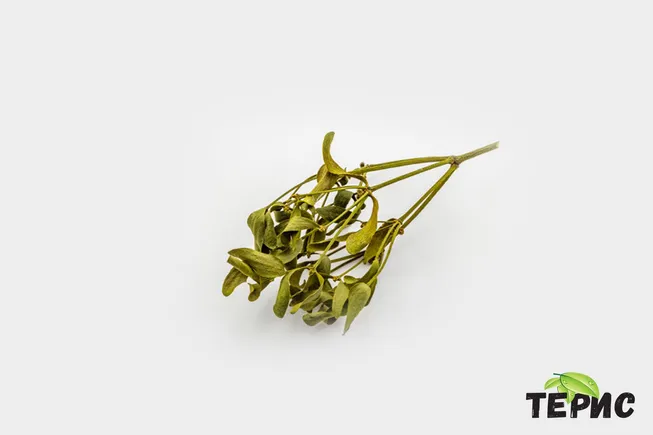
The parts used for medicinal purposes are the shoots and leaves.
Experts say that whole twigs are used, but thinner than 4-5 millimetres, collected in spring during flowering, usually in March and April, or when the berries ripen in autumn. The berries must be collected carefully when they come loose, as they are very fragile and scatter.
In Bulgaria, nearly 7,500 kg of shoots are collected each year, and an average of 4,700 kg of leaves a year.
Drying is done in the shade at a low temperature. If it is dried at over 45 °C it loses its medicinal properties. That is why the primary processing, and then the way of storing it, is very important. It is very hygroscopic and draws moisture from the air; even if it is fully dried and stored in paper sacks, it can take up moisture again and spoil.
#Medicinal properties of white mistletoe
It is usually found in the crowns of broadleaved trees, especially apple, linden, hawthorn and poplar. It is believed that the mistletoe shrubs with the highest medicinal effect are those collected from coniferous trees - mostly from pine. Among the broadleaved hosts, willows along riverbeds may be good for collecting mistletoe, because a strong effect on lowering high blood pressure has been demonstrated there.
- It lowers high blood pressure and normalises low blood pressure
The shoots and leaves of the herb have a mainly hypotensive action and are used to lower high blood pressure and normalise low blood pressure.
- Used in the early stage of hypertensive disease
It is used mainly in the early stage of hypertensive disease. In the treatment of hypertension, a lowering of blood pressure, a weakening or disappearance of headaches and an improvement in sleep are observed.
- It has a depressant action on the central nervous system
- It has a direct vasodilating action on the lower limbs and the liver
- It has a haemostatic action
- It supports increased activity of protein substances
- White mistletoe = a women's herb
White mistletoe is also known as the women's herb, because it is recommended
- for osteoporosis
and can be used preventively, because it helps
- the build-up of calcium in the bones
The herb has been shown to
- influence the autonomic nervous system,
- help with hormonal imbalance during the menopause,
- as well as with premenstrual syndrome
In addition, although to a lesser extent, white mistletoe:
- has an antitussive action,
- helps against convulsions,
- also has a calming action,
- helps the blood to clot
- and dilates the blood vessels
- slows the heart rate,
- improves heart function,
- tones the myocardium.
The herb is also given:
- for uterine bleeding,
- nosebleeds,
- very prolonged menstruation
- or bleeding haemorrhoids.
It is also used:
- for trembling hands,
- for diseases of the nervous system,
- for headaches,
- neuralgia,
- for chronic joint diseases.
White mistletoe is even used in some cancers.
The plant is used to treat epilepsy and atherosclerosis. It regulates irregular menstruation and helps with female infertility, kidney problems, nervous disorders, bouts of anxiety and panic, insomnia, vertigo and headaches.
White mistletoe has a haemostatic and clotting action, which is why it is suitable for heavy and prolonged menstruation, as well as for bleeding haemorrhoids. White mistletoe is also drunk to increase lactation in breastfeeding mothers. In small doses it treats convulsions and spasms.
External use of white mistletoe
Externally, white mistletoe is used for wounds, frostbite, ulcers and varicose veins. The medicinal action of white mistletoe is applied in the form of a cold infusion or as a decoction.

#How to take white mistletoe
The best
“way to take white mistletoe is as a concentrated herbal extract (herbal tincture), a cold infusion or a decoction”
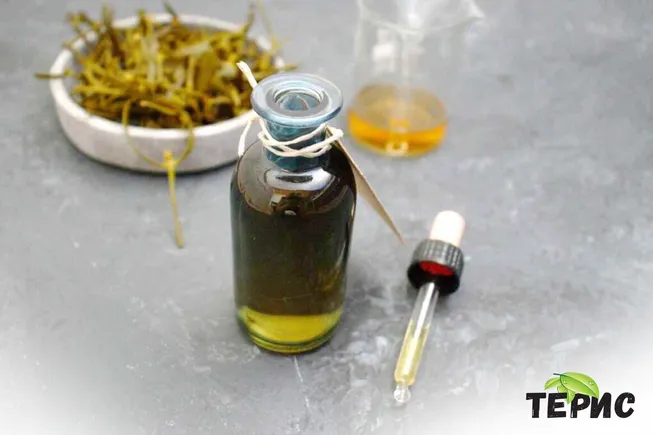
- As a herbal tincture
Taken this way, the herb is at its strongest and most concentrated!
If you are wondering what a tincture is, we will try to explain briefly:
The usable parts of the plant are left to soak in deionised water and ethyl alcohol for at least two weeks to increase the concentration.
Tinctures help you absorb concentrated herbal and plant properties faster than, for example, drinking tea allows, which is why you can see the effects of tinctures more quickly!
- To make a cold infusion
- pour 200 ml of cold water over two teaspoons of white mistletoe and leave to soak for 12 hours. Then strain the mixture and drink the infusion in the morning. Pour the same amount of water over the same herb and drink the infusion in the evening.
- For a decoction
- pour 300 ml of boiling water over 1 tablespoon of the herb and boil for 5 minutes. Leave to steep for 30 minutes, strain and drink 80 ml 3 times a day after meals.
- In the form of a bath
- white mistletoe helps with rheumatism, sciatica, joint pain, swelling, etc. Baths are prepared from white mistletoe extract or an infusion.
Possible contraindications:
Not recommended during pregnancy, in cases of individual intolerance, or chronic kidney failure. Its use must be precise and great care must be taken, because in large amounts it is toxic. So do not forget always to consult a health adviser or specialist.
#White mistletoe
White mistletoe is known as the Christmas shrub under which people kiss, and it has a number of medicinal properties. It enriches the body with calcium, which is important for the skeletal system; regulates arterial blood pressure in both hypertensive and hypotensive people; improves heart health; helps with hormonal imbalance in women around the menopause; regulates metabolism; is used in the treatment of atherosclerosis and epilepsy; regulates menstruation; and eases kidney disease, female infertility, bronchial asthma, nervous disorders, panic attacks, vertigo and disorders of the vestibular system. It has a haemostatic and clotting action, and it also increases lactation in breastfeeding mothers.
Besides the many ancient beliefs and superstitions about this evergreen plant, do not forget to take advantage of the health benefits it has.
White mistletoe - the ancient medicinal plant ➤ VIDEO
This article is for educational purposes and does not replace advice from a doctor. Food supplements are not medicines and are not intended to treat diseases. If you have a chronic condition, are pregnant or breastfeeding, or take medication, consult a specialist before use.

White Mistletoe - The Ancient Medicinal Plant
Click to play video