The Month of Love and the Romantic Holiday
Table of Contents
#February - the month of love!
Saint Valentine's Day, also called the lovers' holiday, is celebrated every year on 14 February by many people all over the world.

#Saint Valentine's Day customs
Saint Valentine's Day customs include sending greeting cards (known as "valentines"), giving confectionery or presenting flowers - an expression of love.

#The story of Cupid
We all associate the holiday with the story of CUPID :)
In classical mythology, Cupid (from the Latin Cupīdō, meaning "passionate desire") is the god of desire, erotic love, attraction and affection.
He is also known in Latin as Amor ("Love").
Cupid - the ancient Roman god of love in all its varieties, the counterpart of the Greek god Eros and the equivalent of Amor in Latin poetry.
He is often personified as a winged baby carrying a bow and a quiver of arrows, whose wounds inspire love or passion in each of his victims.
In modern popular culture, Cupid is shown drawing his bow to inspire romantic love, often as an icon of Saint Valentine's Day.
CUPID is the best-known symbol of Saint Valentine's Day - a mischievous, winged child armed with a bow and arrows who aims his arrows at people, making them fall deeply in love.

#The Saint Valentine's Day holiday
The holiday of love has become an occasion for celebration for many people around the world.
Saint Valentine's Day is not a public holiday in any country, although it is an official feast day in the Anglican Communion and the Lutheran Church.

It developed in early modern England and spread throughout the English-speaking world in the 19th century. In the late 20th and early 21st centuries these customs spread to other countries, like those of Halloween, or aspects of Christmas (such as Father Christmas).
#The legend of Cupid!
According to myth, Cupid is the son of Mercury, the winged messenger of the gods, and Venus, the goddess of love.
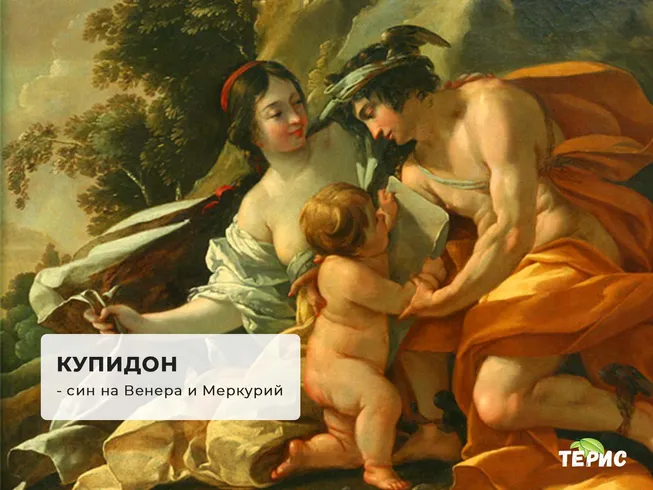
He is sometimes depicted in armour like that of Mars, the god of war, perhaps to suggest ironic parallels between war and romance or to symbolise the invincibility of love.
#The legend of Cupid according to Roman mythology
In Roman mythology, Cupid's mother Venus was jealous of Psyche's beauty and ordered Cupid to punish her with death. Instead, Cupid fell deeply in love with her. But as a mortal she was forbidden to look at him.
Psyche was happy until her sisters persuaded her to look at Cupid. As soon as she looked at Cupid, he punished her by leaving. Their beautiful castle and gardens vanished too. Psyche found herself alone in an open field with no trace of anyone else or of Cupid.
While wandering in search of her love, she came across the temple of Venus. Wishing to destroy her, the goddess of love gave Psyche a series of tasks. Psyche was given a small box and told to take it to the underworld to capture some of the beauty of Proserpina, the wife of Pluto.
During the journey she was given advice on avoiding the dangers of the realm of the dead and was warned not to open the box. But temptation overcame Psyche and she opened the box. Instead of finding beauty, she found a deadly sleep.
Cupid found her lifeless on the ground. He gathered the deadly sleep from her body and put it back in the box. The gods, moved by Psyche's love for Cupid, turned her into a goddess.
Today Cupid and his arrows have become the most popular signs of love and of love itself.
It is often depicted as two hearts pierced by an arrow - Cupid's arrow.

#Cupid - Amor - Love
Cupid is also known in Latin as Amor ("Love").
His Greek counterpart is Eros. Although he is usually depicted as a slender winged youth in classical Greek art, during the Hellenistic period he was increasingly portrayed as a chubby boy.
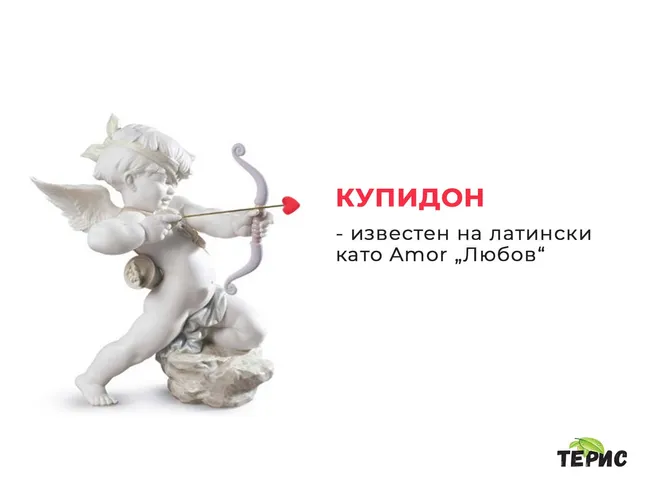
During this time his iconography acquired the bow and arrows that represent his source of power: a person, or even a deity, who is shot by Cupid's arrow is filled with uncontrollable desire.
In the myths, Cupid is a minor character who serves mostly to set the plot in motion. He is a main character only in the tale of Cupid and Psyche, when he is wounded by his own weapons and goes through the ordeal of love. Although no other detailed stories are told about him, his tradition is rich in poetic themes and visual scenarios, such as "Love conquers all" and Cupid's revenge or torments. His powers are similar, though not identical, to those of Kamadeva, the Hindu god of human love.
Cupid continued to be a popular figure in the Middle Ages, when under Christian influence he often had a dual nature as heavenly and earthly love.
During the Renaissance, renewed interest in classical philosophy endowed him with complex allegorical meanings.
#The legend of the first valentine card
Saint Valentine was "a priest of Rome who was imprisoned for helping persecuted Christians."
An account of the imprisonment of Saint Valentine of Rome:
It tells that Saint Valentine was persecuted as a Christian and personally interrogated by the Roman Emperor Claudius II. The emperor was impressed by Valentine and held a discussion with him, trying to get him to convert to Roman paganism in order to save his life. Valentine refused and instead tried to convert Claudius to Christianity. Because of this he was executed.
Before his execution he is said to have performed a miracle by healing Julia, the blind daughter of his jailer Asterius. She and her forty-six-member household (family members and servants) came to believe in Jesus and were baptised.
According to this early tradition, Saint Valentine restored the sight of his jailer's blind daughter.
The legend is linked to the theme of love - it is claimed that he wrote the jailer's daughter a letter signed "Your Valentine" as a farewell before his execution.
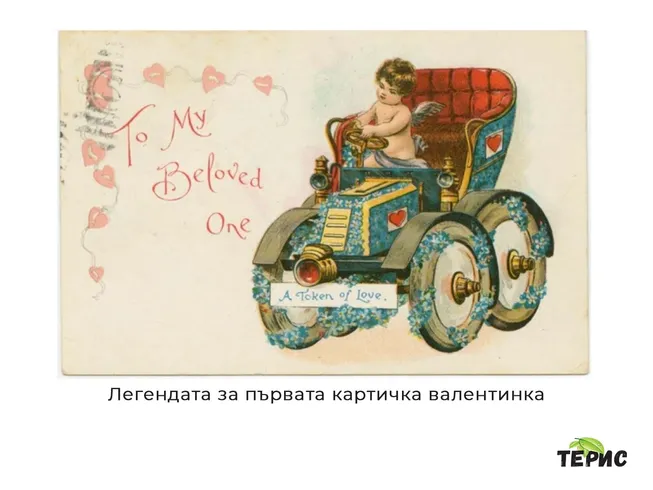
The phrase "From your Valentine" was later adopted in modern Valentine's Day letters.
Saint Valentine is said to be buried in the church of Praxedes in Rome, located near the cemetery of Saint Hippolytus. This account says that, according to legend, "Julia herself planted a pink-blossoming almond tree near his grave. Today the almond tree remains a symbol of abiding love and friendship.
#Another legend says that…
Another embellishment suggests that Saint Valentine performed secret Christian weddings for soldiers who were forbidden to marry. The Roman Emperor Claudius II supposedly banned this in order to grow his army, believing that married men did not make good soldiers. However, George Monger writes that this marriage ban was never issued and that Claudius II told his soldiers to take two or three wives for themselves after his victory over the Goths.
According to legend, in order to "remind these men of their vows and of God's love, Saint Valentine cut hearts out of parchment", giving them to these soldiers and to persecuted Christians - a possible origin of the widespread use of hearts on Saint Valentine's Day.
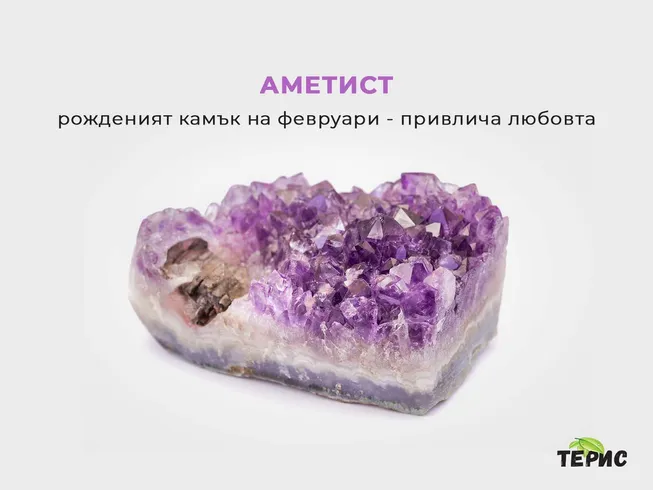
It is believed that Saint Valentine had a purple amethyst ring, customarily worn on the hands of Christian bishops, engraved with an image of Cupid, a recognisable symbol associated with love that was legal under the Roman Empire.
Roman soldiers recognised the ring. Probably because of the association with Saint Valentine,
the amethyst became the birthstone of February, which is believed to attract love
#Why 14 February
The feast of Saint Valentine was established by Pope Gelasius I in 496 AD, to be celebrated on 14 February in honour of Saint Valentine of Rome, who died on that date in 269 AD.
The day became associated with romantic love in the 14th and 15th centuries, when notions of courtly love flourished, apparently because of the association with the "lovebirds" of early spring.

In 18th-century England it grew into an occasion on which couples expressed their love for each other by giving flowers, offering confectionery and sending greeting cards (known as "valentines").
The Saint Valentine's Day symbols used today include the heart-shaped outline, doves and the figure of the winged Cupid.
From the 19th century, handwritten valentines gave way to mass-produced greeting cards. In Italy, Saint Valentine's keys are given to lovers "as a romantic symbol and an invitation to unlock the giver's heart", as well as to children to ward off epilepsy (called Saint Valentine's Malady).
#What is LOVE?
Love encompasses a range of strong and positive emotional and mental states, from the most sublime virtue or good habit and the deepest interpersonal affection to the simplest pleasure.
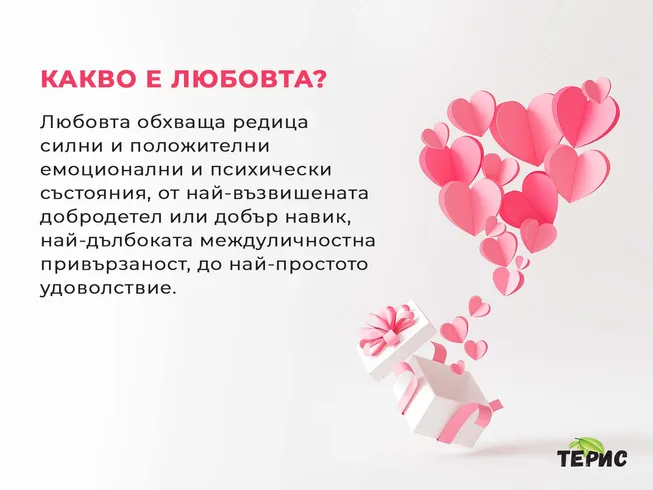
When you love someone, you want them to be healthy and happy!
An example of this range of meanings is that a mother's love differs from a spouse's love, which differs from the love of food. Most often, love refers to a feeling of strong attraction and emotional attachment.
Love is considered both positive and negative: its virtue represents human kindness, compassion and affection, as "the unselfish loyal and benevolent concern for the good of another", while its vice represents a human moral flaw akin to vanity and selfishness, potentially leading people to a kind of mania, obsessiveness or codependency.
It can also describe compassionate and affectionate actions towards other people, oneself or animals. In its various forms, love acts as a major facilitator of interpersonal relationships and, owing to its central psychological importance, is one of the most common themes in the creative arts. It has been postulated that love is a function that keeps people together against threats and facilitates the continuation of the species.
#Love according to the ancient Greek philosophers
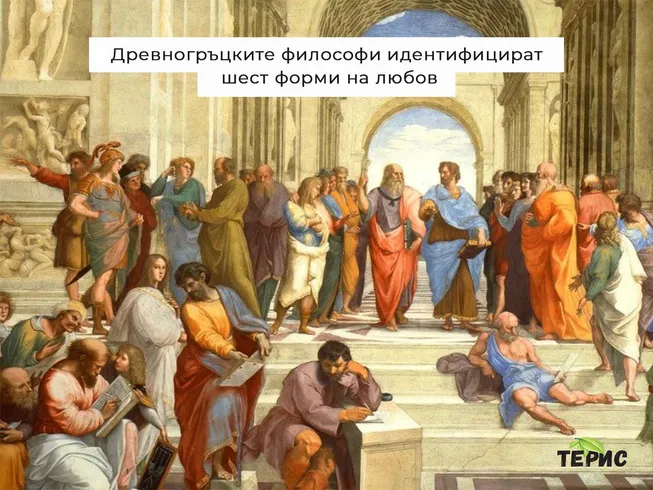
The ancient Greek philosophers identified six forms of love:
- essentially familial love (in Greek, Storge),
- friendly love or platonic love (Philia),
- romantic love (Eros),
- self-love (Philautia),
- love of guests (Xenia)
- and divine love (Agape)
#Love according to modern authors
Modern authors distinguish further varieties of love:
- unrequited love
- empty love
- companionate love
- consummate love
- infatuated love
- self-love
- and courtly love
Scientific research on emotions has increased significantly over the last two decades.
#The colour wheel of love
The colour wheel theory of love defines three primary, three secondary and nine tertiary love styles, describing them in terms of the traditional colour wheel.
The triangular theory of love suggests that "intimacy, passion and commitment" are the core components of love.
Love has an additional religious or spiritual meaning. This diversity of uses and meanings, combined with the complexity of the feelings involved, makes love unusually difficult to define consistently compared with other emotional states.

#Love… Love… Love…
What more do we need… apart from being healthy… than to love and be loved…!
So love, care for and delight your beloved every day!

#THE MONTH OF LOVE WITH YOUR BELOVED WOMAN
Delight your BELOVED with a drop of health ➡ "ZA ZHENATA" (For Women) set - daily care for every lady.
Give the gift of health to your BELOVED woman!
The natural "ZA ZHENATA" set contains 8 herbal tinctures and is based entirely on herbal products.
It supports the functions of the entire female reproductive system.
Each of the tinctures in this set, taken daily, will support a woman's daily health care.

The "ZA ZHENATA" set contains 8 bottles of herbal tinctures that will support the natural strengths of the fairer half.
They are aimed at supporting:
- the female reproductive system
- the breasts
- cycle problems
- the digestive tract
- the nervous system
- the thyroid gland
The "ZA ZHENATA" set contains 8 bottles of herbal tinctures:
Herbal tincture GRIZHA ZA ZHENATA - 2 pcs.
Herbal tincture HORMONALEN BALANS
Herbal tincture MELISA
Herbal tincture ASTRAGALUS
Herbal tincture KALENDULA
Herbal tincture MENTA
Herbal tincture BALANS
Delight your BELOVED with the perfect gift for her from bilkovitinkturi.bg
Love and be loved!
#THE MONTH OF LOVE WITH YOUR BELOVED MAN
The perfect gift for him:
What could be better than delighting your other half with something healthy?
Give the gift of health to your BELOVED with the "ZA MAZHA" (For Men) set
We have created a specially selected herbal ZA MAZHA set - daily care for the stronger sex.

This set contains 8 tinctures - supporting the functions of the entire male reproductive system and the natural male strength - and is based entirely on herbal products.
It includes:
Herbal tincture TRIBULUS - 2 pcs.
Herbal tincture EPILOBIN
Herbal tincture MURSALSKI TEA
Herbal tincture BETULA
Herbal tincture TONUS
Herbal tincture TOKSIKLIYN
Herbal tincture GERANIUM
It supports:
- the male reproductive system
- the prostate
- the urinary system
- physical strength
- testosterone
- cleansing of the liver
Love and be loved. Order online from bilkovitinkturi.bg
#14 February
14 February - the day on which we celebrate and show our other halves our love for them.

LOVE and BE LOVED with bilkovitinkturi.bg
Delight your BELOVED with a drop of health!
#
THE MONTH OF LOVE AND THE ROMANTIC HOLIDAY ➤ VIDEO
This article is for educational purposes and does not replace advice from a doctor. Food supplements are not medicines and are not intended to treat diseases. If you have a chronic condition, are pregnant or breastfeeding, or take medication, consult a specialist before use.

The Month of Love and the Romantic Holiday
Click to play video